Dog Body Language During Play: When to Pause
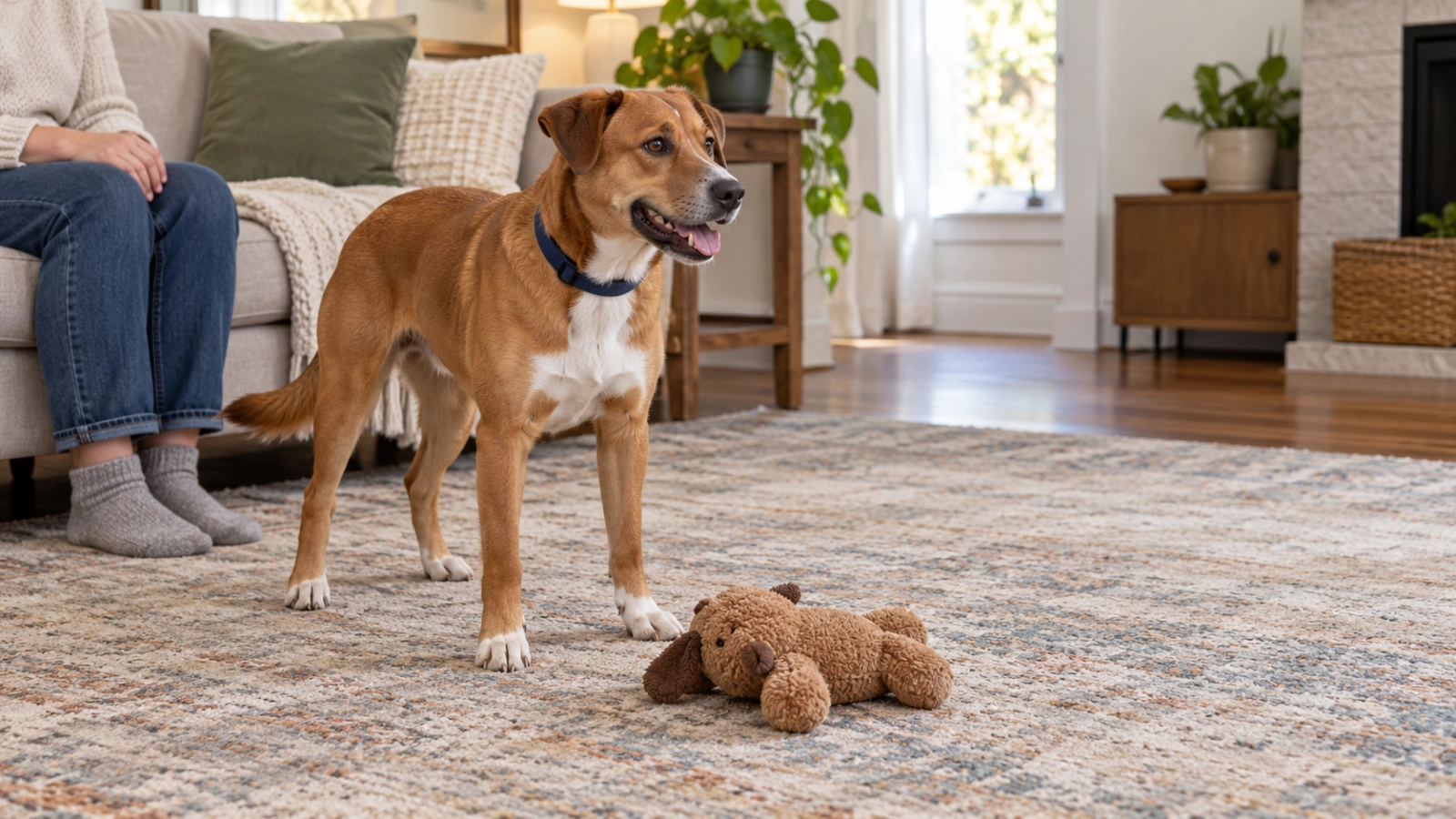
When play changes from easy movement to repeated avoidance, stiffness, or contact that is getting harder to manage, pause. You do not need to identify an exact emotion before giving your dog more room. Watching dog body language during play means following the whole interaction, including what happened just before the change.
This guide offers an observation routine for everyday play with a person or another dog. It does not determine whether a dog is safe to approach or provide treatment for aggression. For activity ideas, see our indoor games for dogs in small spaces; use the observations here to decide when an activity needs a break.
Start With the Dog and the Setting
Before starting, check the practical details: Can your dog turn and leave without being followed? Is the floor suitable for the movement? Are another dog, a visitor, or a noisy appliance changing the situation? Keep children out of rough play and have an adult supervise dog interactions.
Notice your dog’s usual posture and movement during ordinary, undisturbed activities. Ear shape, coat, tail shape, age, and mobility affect what you can see. Compare changes within that individual rather than expecting every dog to look like a body-language illustration.
Watch the sequence: body movement, face, ears, tail, distance, and what happens next. A wag does not automatically mean happiness or an invitation to approach. Lip licking near food has a different context from repeated lip licking while someone reaches toward a dog. Dogs Trust’s body-language guide emphasizes the individual dog, the whole body, and the situation.
Look for Patterns, Not a Single Green Light
Loose movement, a play bow, voluntary approaches, and natural breaks can occur in playful interactions. With two dogs, notice whether both have opportunities to stop and whether one keeps pursuing after the other tries to leave. Taking turns can be useful information, but play does not need a perfectly equal score.
Growling can occur during play, so sound alone does not settle the question. Read it alongside movement and the response of the other participant. A change toward freezing, a fixed stare, retreating, or repeated attempts to escape deserves attention even if the tail is moving. Do not wait for a growl or snap before offering space.
These observations help you make a cautious decision; they cannot guarantee the next moment. Dogs do not always show warnings in a predictable order. When you cannot tell what is happening, ending the activity is a reasonable choice.
A Context-First Play Observation Table
Use this table to describe a change and choose a practical response. The examples are prompts for observation, not labels for a dog’s feelings or a checklist that certifies safe play.
| What changed | What else to observe | A sensible response |
|---|---|---|
| Loose movement becomes still or stiff | What happened immediately beforehand? Is there a fixed gaze, a nearby toy, an approaching hand, or a blocked route? | Stop the game and give space. Do not reach for the dog or the item. |
| The dog turns away or leaves repeatedly | Does the person or other dog follow? Can the dog actually leave the activity? | Stop following or inviting. Keep the other participant from pursuing and allow a quiet break. |
| Lip licking, yawning, or ears held back appear | Look at the rest of the body and the timing. Is food present, has the dog just woken, or did an interaction change? | Pause and remove pressure. Avoid deciding what the dog feels from this observation alone. |
| Chasing or body contact becomes more intense | Can both dogs disengage? Is one repeatedly trying to get behind a person or out of the area? | End the interaction early while a familiar call-away is still workable. Do not force a rematch. |
| Teeth contact a person or clothing during a game | What changed in speed, movement, or toy position? Has this happened before? | Stop adding movement and end the game safely. Seek help for repeated or injurious contact. |
| A growl appears with freezing, retreating, or guarding an item | Is someone approaching, touching, cornering, or reaching for a possession? | Stop the approach, give space, and seek professional advice. Never punish the warning. |
| The dog limps, yelps, or suddenly avoids a familiar movement | Is the change new? Does it also happen outside play? | Stop physical play and contact your veterinarian; do not repeat the movement to test it. |
Offer a Pause That Leaves a Real Choice
For a low-intensity game with you, stop moving the toy and soften your own movement. Leave a clear route away. Do not lean over your dog, hold their collar, or keep waving the toy to obtain a response. If a toy is in their mouth, do not pry it out or wrestle it away.
Wait without asking for another round. Your dog may stay nearby, investigate something else, drink, or leave. Remaining beside you is not automatically a request to play. If they voluntarily bring the toy back or initiate another loose interaction, you can consider a gentler round, provided the earlier concern has resolved. Keep observing after restarting.
With two dogs, arrange pauses before the interaction becomes difficult to interrupt. When it is safe and they can respond, each caregiver can call their own dog away using a familiar, rewarded cue and create separate space. Do not grab collars, reach between dogs, or put hands near mouths to manufacture a pause. If you cannot manage breaks safely, stop arranging that play and get individual support.
A voluntary pause is not a safety test. Returning to another dog or toy does not prove that continued play is comfortable or safe for everyone. Do not hold one dog in place to see whether the other approaches, or release dogs back together just to check their reaction.
Make the Break Useful
Let a dog that disengages remain disengaged. Do not follow them with a toy or send another dog over to encourage them. Provide distance from the activity and access to a place where they can be left alone. Our guide to choosing a dog bed location in a small home can help you plan a resting spot away from busy movement.
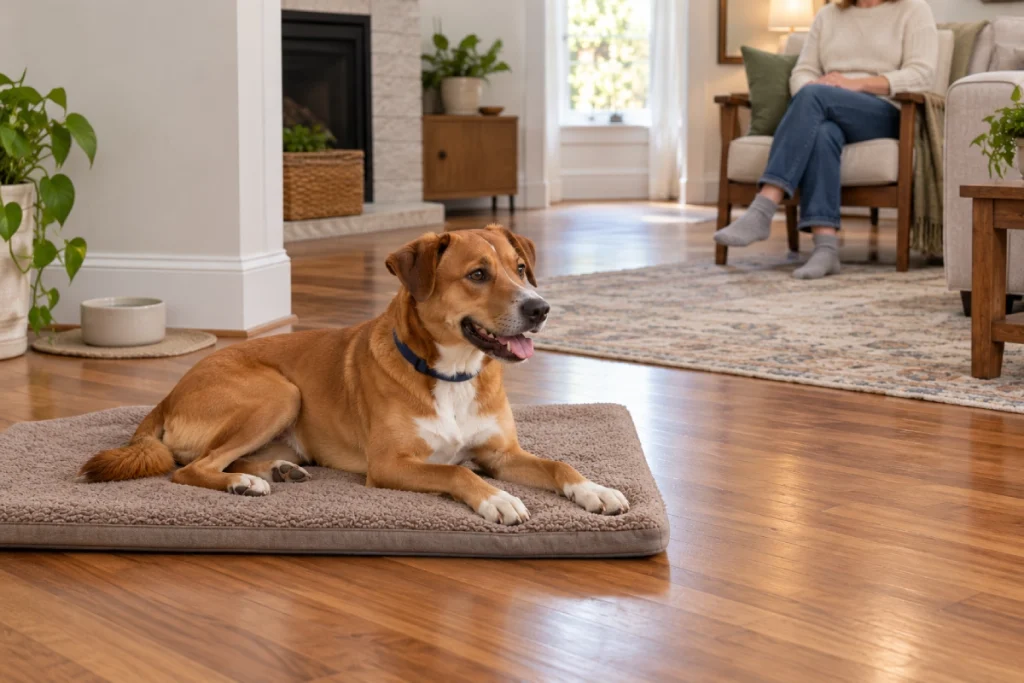
For example, imagine a dog that has been retrieving a toy begins turning toward the hallway after each return. Rather than throw again to regain attention, stop and leave the hallway available. If the dog walks away, the session is over. On another occasion, begin with fewer repetitions or a quieter activity. This is a practical adjustment, not a diagnosis of why the dog left.
If another dog repeatedly ignores attempts to leave, manage the dogs separately instead of asking them to work it out. Dogs Trust’s guidance on fear and frustration supports reducing pressure, allowing choice, and providing undisturbed rest. Some dogs do better with individual activities; dog-to-dog play is not a requirement.
Know When Everyday Adjustments Are Not Enough
Never punish a warning signal. Do not scold, pin, intimidate, or deliberately provoke the dog to see whether the warning happens again. The immediate task is to stop the pressure and prevent another difficult interaction. AVSAB’s current training guidance recommends reward-based methods and rejects physical or psychological punishment.
Contact your veterinarian for a sudden behavior change, limping, yelping, reluctance to move, or concern about pain. Persistent fear, repeated freezing or guarding, snapping, biting, or difficulty safely ending play also calls for professional support. Ask your veterinarian about a board-certified veterinary behaviorist or an appropriately qualified behavior professional who uses reward-based methods and works with veterinary care when needed.
While waiting, avoid the situations that have led to trouble and keep affected people or animals safely separated. Do not recreate the interaction to record it. If a person is bitten or injured, obtain medical advice; arrange veterinary care for an injured animal.
Keep a short factual note for your appointment: who was present, the activity, what happened before the change, what the dog did, and what happened when space was provided. “Stopped moving when I approached the toy” is more useful than “became stubborn.” Your role is to notice and respond, not prove what your dog was feeling.