9 Indoor Games for Dogs in Small Spaces
Indoor games for dogs in small spaces work best when you match the activity to the room and the dog. A food search needs a small patch of floor; a retrieve needs a clear route. Your dog’s interests, health, mobility, and ability to take a break matter more than completing every game on a list.
Pick one option below, try its easiest version, and stop while the session is still going well. These games add variety to the day; they do not automatically replace walks, bathroom trips, or your dog’s individual exercise needs.
Prepare a Small, Suitable Play Area
Clear the floor of cords, loose objects, and anything your dog could knock over. Keep doors, stairs, and busy household routes outside the game. For a puppy, our room-by-room puppy-proofing checklist can help you inspect the area.
Choose a surface with secure traction. A rug or mat should stay flat and not slide as the dog moves. If you cannot provide a clear, nonslip route, choose a stationary game instead of a retrieve or walking activity.
Supervise throughout. Choose toys for the dog’s size and chewing habits, inspect them for damage, and remove damaged items. Skip homemade toys with swallowable pieces. If your dog has pain, an injury, or exercise restrictions, ask your veterinarian which activities fit their care plan.
Before buying a play toy, use our guide to choosing the right size dog toy to check dimensions, intended use, and condition.
Choose a Game for the Space You Have
The space descriptions below are practical starting points, not fixed measurements. Allow for your dog’s whole body, your own movement, and room to turn without bumping furniture.
| Game | Space needed | Equipment | Easy first version |
|---|---|---|---|
| 1. Find It | Small clear floor patch | A few pieces of suitable food | Place food in plain sight for the dog to locate. |
| 2. Find Your Person | Clear route around one corner | An adult helper; optional reward | Call from partly behind a nearby doorway. |
| 3. Gentle Tug | Room for dog and adult to stand comfortably | Suitable tug toy; second toy for a swap | Offer a brief, low tug, then pause. |
| 4. Short-Distance Retrieve | Straight, nonslip route | Soft, appropriately sized toy | Place the toy nearby instead of throwing it. |
| 5. Nose-to-Hand Touch | Standing space beside you | Your open hand; reward | Reward one voluntary nose touch. |
| 6. Name That Toy | A small floor area | One familiar toy; optional second toy | Pair one consistent name with one toy. |
| 7. Simple Food Puzzle | Stable spot beside you | Dog-designed puzzle and suitable food | Leave the first food compartment easy to access. |
| 8. Go to Your Mat | Space for the dog’s mat and approach | Nonslip mat and food rewards | Reward investigating or stepping onto the mat. |
| 9. Follow the Leader | A few clear walking steps | Reward; no obstacles | Walk two slow steps together, then stop. |
Food in these starting versions: Games 1, 7, and 8 use food. Games 3 and 4 can use toys alone. For games 2, 5, 6, and 9, choose food or another reward your dog values, such as a brief toy game. Praise only works as a reward if your dog enjoys it.
For more choices that use no edible rewards, explore our food-free enrichment ideas for dogs.
For food games, set aside suitable food from the dog’s measured daily allowance rather than adding an extra meal’s worth. Follow any prescribed diet. Dogs Trust’s enrichment advice recommends considering dietary needs, abilities, preferences, and supervision when choosing activities.
Nine Games to Try
1. Find It: Search for Food
Let your dog watch you place a few pieces of food on a clean, clear floor. Say “find it” and let them investigate. Begin with visible pieces close together. Later, spread them slightly farther apart while keeping them reachable. Avoid hiding food under heavy furniture or anywhere the dog must squeeze or climb.
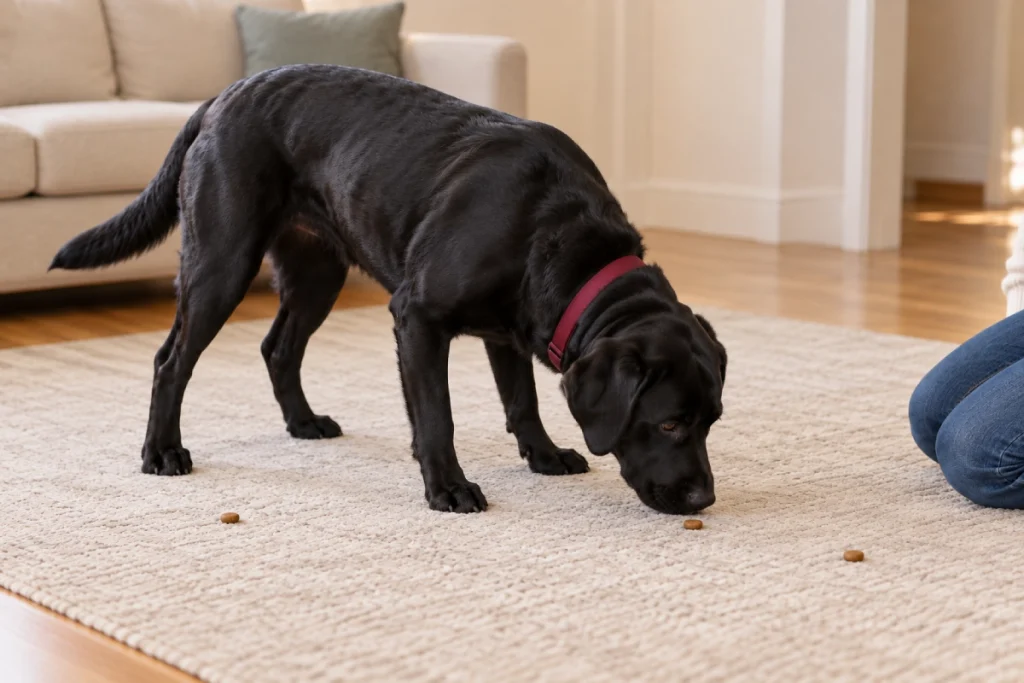
For a step-by-step version with a toy option and easier resets, see how to play Find It with your dog indoors.
2. Find Your Person
Ask another adult to stay with your dog while you move just around a nearby interior corner, remaining partly visible. Call once and reward your dog when they come to you. Start close enough that they can succeed without rushing. If the dog becomes worried when you disappear, stay visible and make the game easier.
This is a simple version of the person-search game in the AKC’s cognitive training games guide. Keep the route on one level, with no closed doors or climbing to reach the person.
3. Gentle Tug
Offer a suitable tug toy with enough space between your hand and the dog’s mouth. Keep it low and use gentle movements. Let the dog take the toy, then pause and use a learned drop cue or offer a second toy for an exchange. Never lift the dog by the toy or jerk it upward.
Battersea’s play guidance recommends keeping tug low rather than sharply jolting upward. If teeth contact skin or the game becomes difficult to manage, stop moving the toy and take a break.
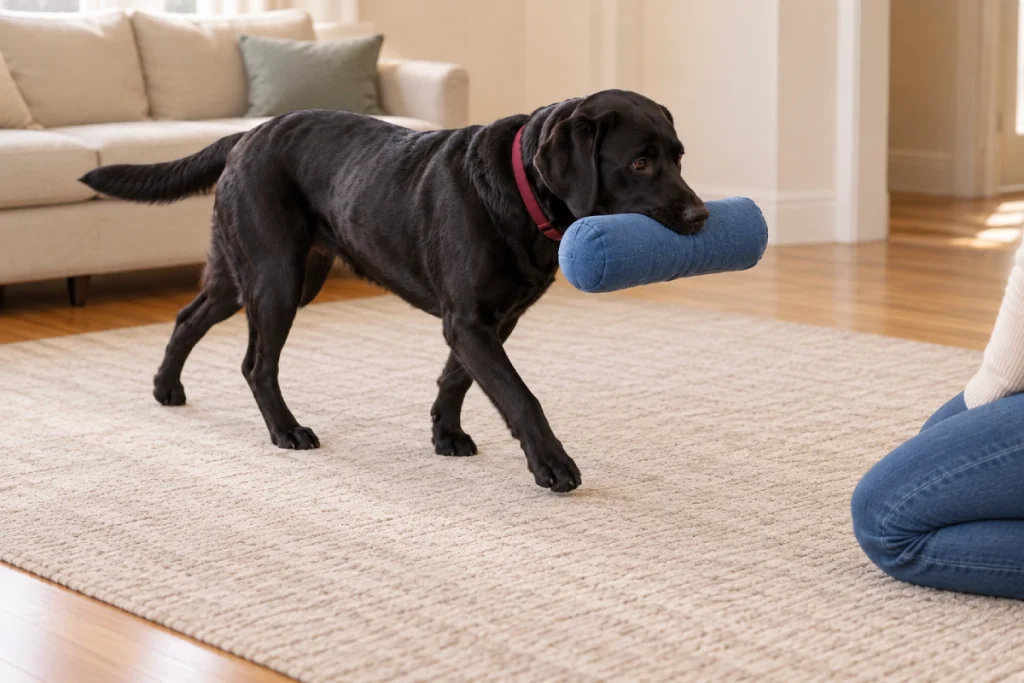
4. Short-Distance Retrieve
Start by placing a soft toy a short distance away on the nonslip surface. Invite your dog to pick it up, then offer another round when they bring it back and release it. Exchange for a second toy if needed. Only introduce a gentle floor-level roll if the dog can walk to it without sliding, racing, or colliding with furniture.
Choose another game if your room cannot provide that route. A hallway is not automatically suitable simply because it is long.
5. Nose-to-Hand Touch
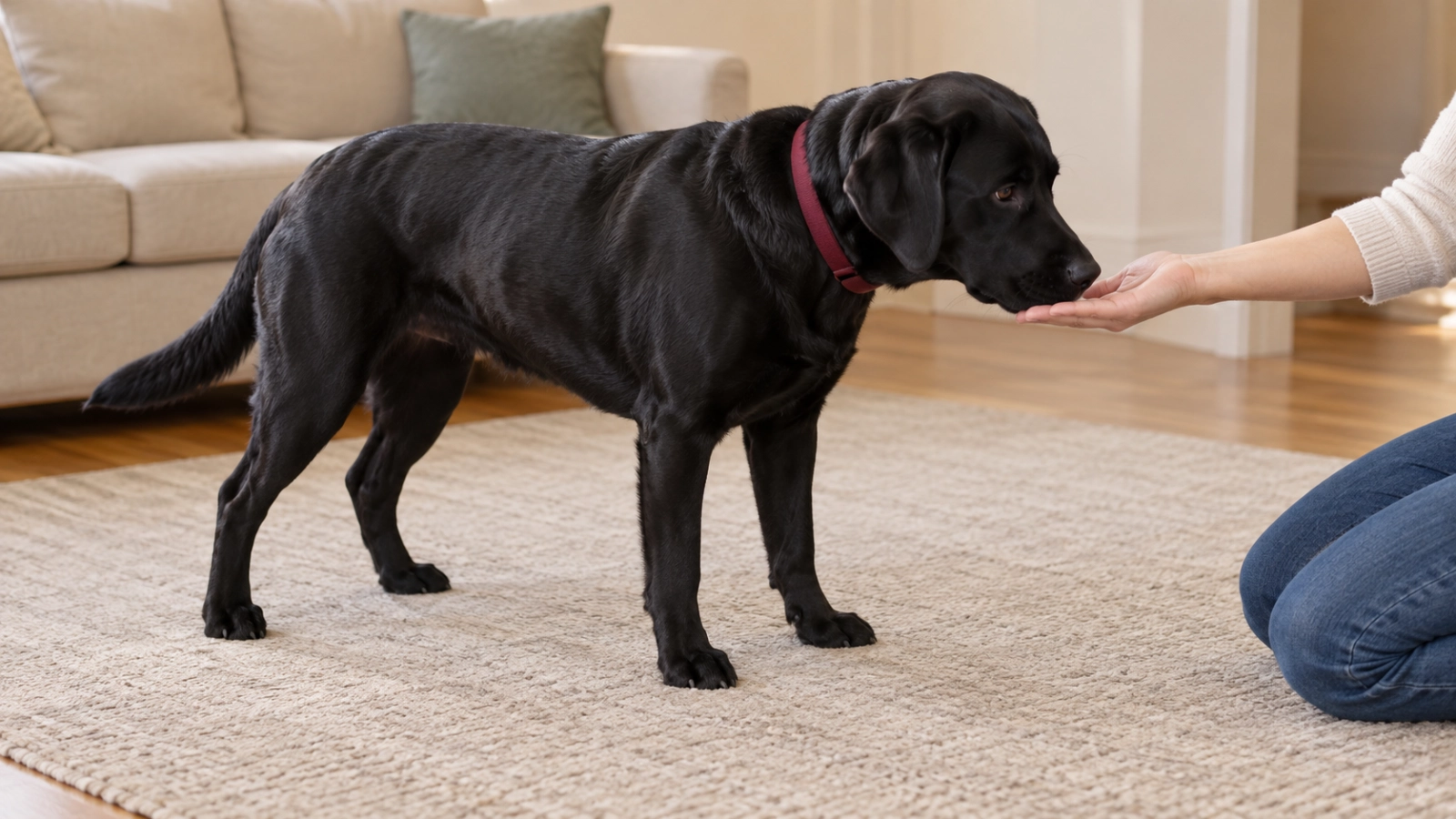
Present an open hand close to your dog’s nose, at a comfortable height. Let them choose to investigate. When their nose touches your palm, mark the moment with a familiar “yes” and provide a reward. Withdraw your hand and reset. Keep the hand easy to reach without jumping; do not push it into the dog’s face.
Dogs Trust’s target-training guide explains how to build this skill gradually. If you use a marker word, teach its association with a reward first; the AKC’s mark-and-reward guide explains that foundation.
6. Name That Toy
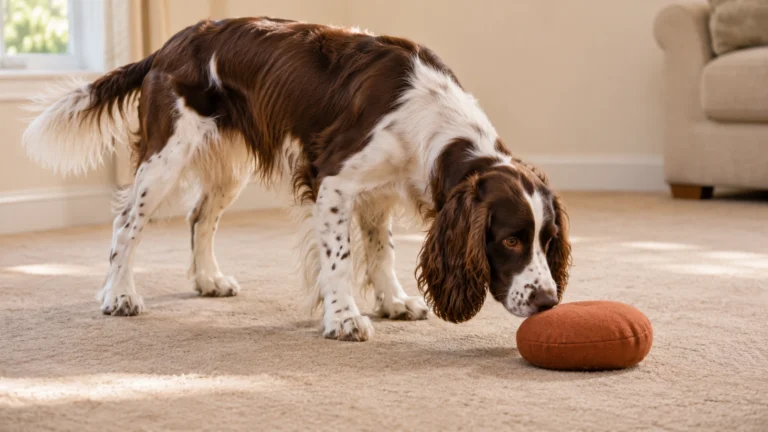
Choose one familiar toy and use the same short name when offering it for play. Reward your dog for engaging with it. After that association is familiar, place it beside a less exciting dog toy and ask for the named one. Return to one toy if the choice is confusing.
The goal is choosing an object, rather than chasing it across the room. The AKC’s toy-name training guide describes gradual practice; there is no deadline for learning the distinction.
7. Simple Food Puzzle
Use a dog-designed food puzzle suited to your dog, following its actual instructions. Start at the easiest setting with food easy to access, and stay beside your dog. Show how a moving part works if needed. Put the puzzle away when finished; it is not a chew toy.
Check the manufacturer’s supervision and damage guidance. For example, Outward Hound’s puzzle safety instructions say to supervise closely, prevent chewing, and remove a damaged game. That guidance does not make every puzzle suitable for every dog.
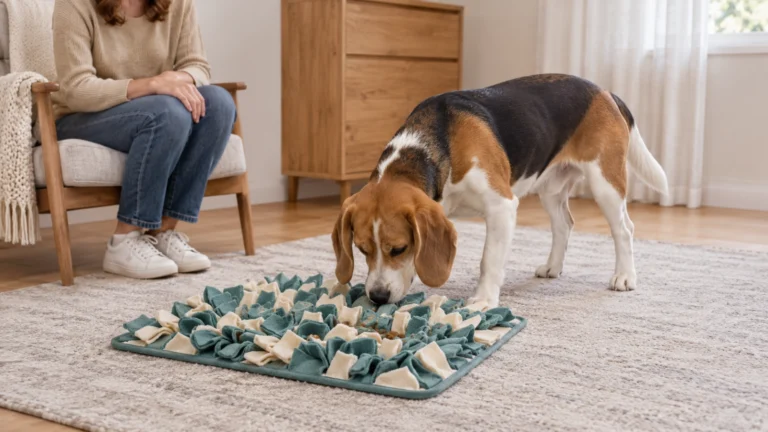
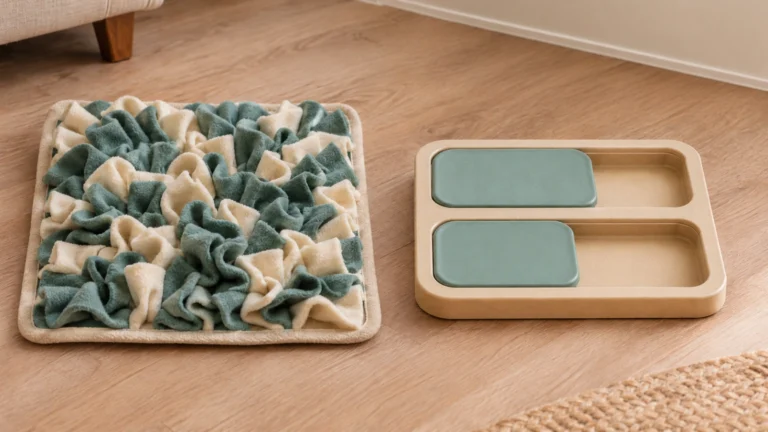
Before choosing equipment, compare a snuffle mat with a puzzle feeder to see which design fits your dog’s habits and your cleanup routine.
8. Go to Your Mat
Put a nonslip mat in a clear spot. Reward your dog for looking at it, investigating, or stepping onto it. Gradually reward more paws on the mat, then a brief pause there. Let the dog move away freely. This is learning a resting station, not a race or a requirement to remain still for a long time.
Battersea’s mat-training steps show a gradual progression. Use a practice mat during the game and leave a sleeping dog’s resting place undisturbed.
9. Follow the Leader
Invite your dog to join you, take two slow steps across the clear area, and reward them for moving beside you. Stop, reset, and try again. Add a broad, gentle turn only when there is room. Avoid tight spins, obstacles, and a chase around your legs.
This adapts the short movement-and-reward practice described in the AKC’s walking-training guide to a supervised indoor game. A stationary touch game is a better choice if either of you cannot move comfortably through the space.
Make the Game Easier or Quieter
- Shorten it: use one search location, one toy, or a couple of steps.
- Show the answer: keep food visible or the person partly in sight.
- Reduce movement: place a toy instead of rolling it, or choose a stationary game.
- Lower the noise: use a quiet reward word and a toy without a squeaker.
- Allow breaks: pause if the dog repeatedly turns away, leaves, or has trouble with the task.
For a closer look at changes during a game, read our guide to dog body language during play and when to pause.
If your dog stiffens, freezes over a toy, or appears uncomfortable when you approach, give them space and do not reach in to take it. Dogs Trust’s resource-guarding guidance recommends veterinary and behavior support. Get advice before restarting games involving an item the dog guards.
Finish With Rest and Everyday Care
Offer water and an opportunity to rest, rather than moving straight through all nine games. Our guide to choosing a dog bed location in a small home can help you keep the resting area separate from household movement.
Continue appropriate walks, bathroom breaks, sniffing opportunities, and other care that suits the individual dog. Indoor play is one part of that routine. You can begin with one enjoyable game and repeat it another day without filling the room with extra equipment.
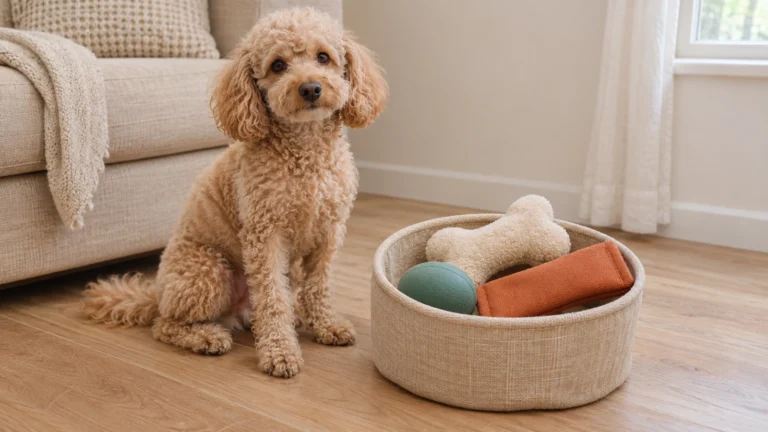
Use a simple dog toy rotation to keep suitable favorites available and store the rest without adding more equipment.
Sources and Further Reading
- Dogs Trust: Enrichment Activities for Dogs
- AKC: Cognitive Training Games for Dogs
- Battersea: How to Play With Your Dog
- Dogs Trust: Target Training
- AKC: Mark-and-Reward Training
- AKC: Teaching Toy Names
- Outward Hound: Puzzle Safety and Care
- Battersea: Mat and Settle Training
- AKC: Walking Training
- Dogs Trust: Resource Guarding